

Global Ammunition Market to Hit US$ 40.34 Billion by 2035 at 6.50% CAGR; Amid Rising Defense Investments
Global Ammunition Market
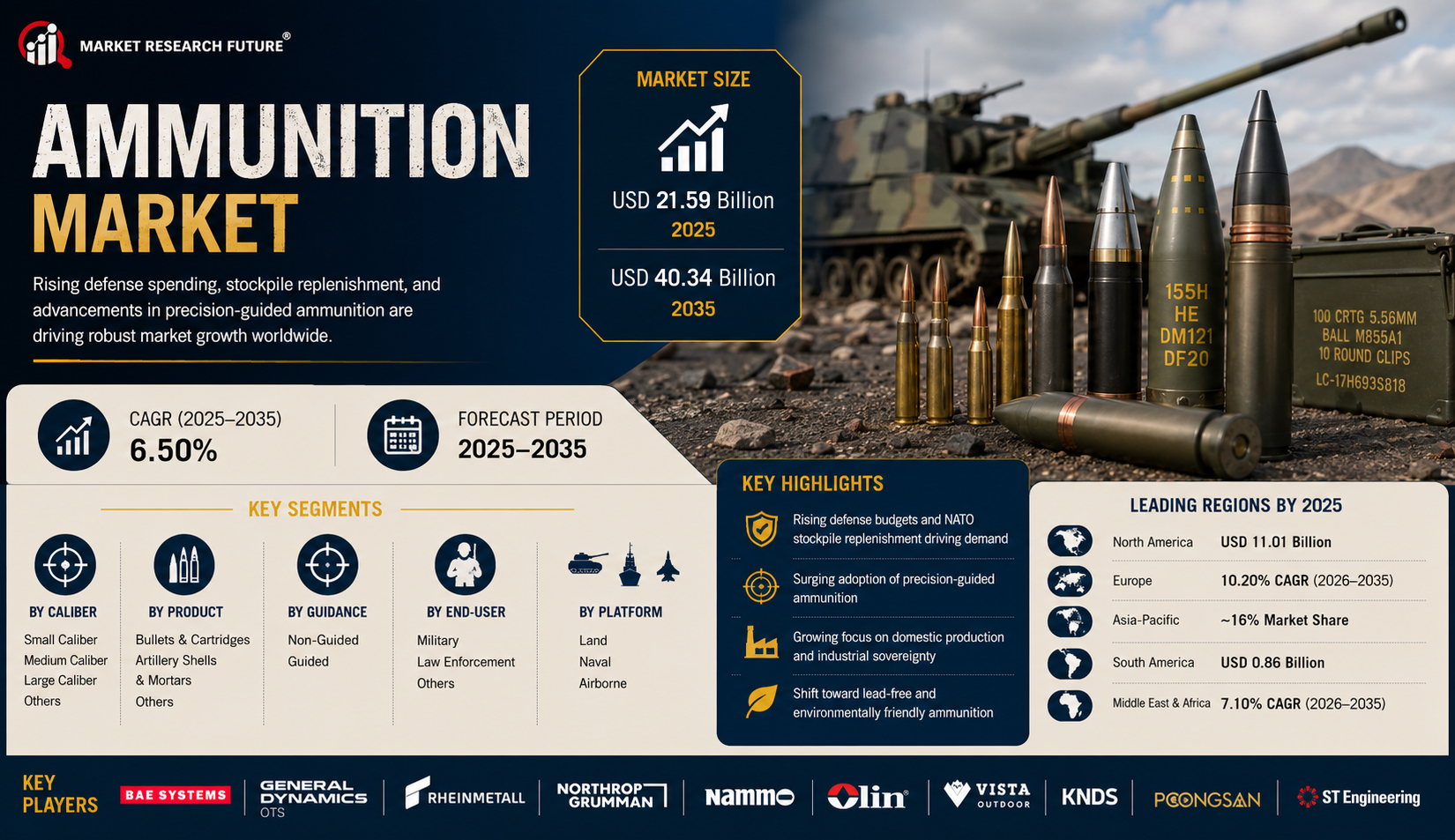
Ammunition market is expected to grow from USD 21.59 Billion in 2025 to USD 40.34 Billion by 2035, registering a CAGR of 6.50% during the forecast period.
NEW YORK, NY, UNITED STATES, July 23, 2026 /EINPresswire.com/ -- The global ammunition market is entering a sustained growth phase, underpinned by escalating geopolitical tensions, modernization of armed forces, and increasing emphasis on strategic defense preparedness.Ammunition serves as a critical component of defense infrastructure, supporting operational readiness across land, naval, and airborne platforms. The market encompasses a diverse range of products, including bullets, cartridges, artillery shells, mortars, and advanced guided munitions. These products cater to multiple end-users such as military forces, law enforcement agencies, and civilian sectors.
The increasing need for stockpile replenishment, technological advancement in guided systems, and expansion of domestic production capabilities are reshaping the industry landscape. As global defense priorities shift toward efficiency, precision, and sustainability, the ammunition market is evolving into a more technologically advanced and strategically significant sector.
Latest Market Trends:
The ammunition market is witnessing transformative trends that are redefining both demand patterns and production methodologies. These trends are not only shaping current market dynamics but also setting the direction for long-term growth.
Request Sample of Report: https://www.marketresearchfuture.com/sample_request/21389
One of the most significant trends is the rapid adoption of precision-guided ammunition (PGA). Modern warfare increasingly demands higher accuracy, reduced collateral damage, and enhanced mission efficiency. Precision-guided systems, equipped with advanced targeting technologies such as GPS and laser guidance, enable military forces to achieve strategic objectives with minimal resource utilization. This shift toward precision is driving investments in research and development, as well as increasing procurement budgets for advanced munitions.
Another key trend is the focus on strengthening domestic manufacturing capabilities. Countries across Europe, Asia-Pacific, and the Middle East are actively investing in local ammunition production to reduce dependence on imports and ensure supply chain resilience. This trend is particularly evident in regions prioritizing defense self-sufficiency and industrial sovereignty. Governments are incentivizing local manufacturers through subsidies, partnerships, and regulatory support to boost domestic output.
The market is also experiencing a growing emphasis on environmentally sustainable ammunition solutions. Traditional ammunition often contains lead and other hazardous materials, prompting regulatory bodies in developed regions to mandate the use of eco-friendly alternatives. As a result, manufacturers are developing lead-free and non-toxic ammunition, which is gaining traction in both military and civilian applications.
Additionally, automation and digital transformation in manufacturing processes are improving production efficiency and scalability. Advanced technologies such as robotics, artificial intelligence, and smart factory systems are enabling manufacturers to optimize production lines, reduce errors, and meet increasing demand more effectively.
The rise in civilian shooting sports and recreational activities, particularly in North America, is also contributing to market growth. This trend is supporting steady demand for small-caliber ammunition and encouraging manufacturers to expand their product portfolios to cater to this segment.
Market Drivers:
The growth of the ammunition market is driven by several key factors, each contributing significantly to the overall expansion of the industry.
One of the primary drivers is the replenishment of NATO and allied munitions stockpiles, which has become a critical priority due to ongoing geopolitical tensions. Countries in Europe and North America are accelerating procurement activities to ensure readiness for potential conflicts. This driver contributes approximately +1.30% to the overall CAGR, highlighting its strong short-term impact on market growth.
Another major driver is the multi-year procurement programs initiated by the U.S. Department of Defense (DoD). These programs provide long-term contracts to ammunition manufacturers, ensuring consistent demand and financial stability. With an estimated +1.10% contribution to CAGR, this factor supports medium-term growth, particularly in North America.
The European Union’s push for industrial sovereignty, supported by initiatives such as ASAP and EDIRPA, is also a significant growth catalyst. These policies aim to strengthen regional defense manufacturing capabilities, reduce dependency on external suppliers, and enhance strategic autonomy. This driver contributes approximately +0.85% to CAGR, primarily in the short term.
In the Asia-Pacific region, defense modernization efforts are driving demand for advanced ammunition systems. Countries are investing heavily in upgrading their military capabilities to address regional security challenges. This factor contributes around +0.70% to CAGR, reflecting its medium-term impact.
The increasing adoption of precision-guided ammunition is another crucial driver. As military forces prioritize accuracy and efficiency, demand for advanced munitions continues to rise. This trend contributes approximately +0.55% to CAGR, particularly over the long term.
The growth in civilian sporting and recreational shooting activities is also supporting market expansion. This trend is especially prominent in North America, where participation rates in shooting sports are increasing. It contributes around +0.35% to long-term growth.
Finally, environmental regulations promoting lead-free ammunition are influencing product innovation and adoption. These mandates are contributing approximately +0.25% to CAGR, particularly in regions with stringent environmental standards.
Market Opportunities:
The ammunition market presents several lucrative opportunities for stakeholders, driven by evolving industry dynamics and emerging trends.
One of the most promising opportunities lies in the premiumization of precision-guided ammunition. As defense forces increasingly prioritize advanced targeting capabilities, there is a growing demand for high-value munitions. This trend is expected to drive higher profit margins and create long-term growth opportunities for manufacturers.
Another significant opportunity is the development of greenfield manufacturing plants in Eastern Europe. The region is emerging as a strategic hub for ammunition production, supported by increasing demand and government initiatives aimed at strengthening local supply chains. Investments in new production facilities are expected to enhance capacity and improve regional self-sufficiency.
The expansion of domestic production in emerging markets is also creating substantial growth potential. Countries in Asia-Pacific, the Middle East, and South America are focusing on developing indigenous manufacturing capabilities. This shift not only reduces reliance on imports but also opens new avenues for partnerships, technology transfers, and joint ventures.
Additionally, the integration of advanced technologies in ammunition systems presents opportunities for innovation. The development of smart munitions, enhanced targeting systems, and improved materials is expected to drive product differentiation and competitive advantage.
Recent Developments:
July 2023 – The European Commission adopted the Act in Support of Ammunition Production (ASAP) regulation, allocating EUR 500 Million to support 31 ammunition production projects across 15 EU member states. This initiative aims to address shortages of critical ammunition types, particularly 155 mm artillery shells, and strengthen the region’s defense manufacturing capacity.
This development highlights the increasing role of government intervention in the ammunition market. By providing financial support and policy backing, governments are enabling manufacturers to scale production and meet rising demand. Such initiatives are expected to accelerate market growth and enhance supply chain resilience in the coming years.
Profiles of Top Companies:
The ammunition market is characterized by intense competition, with several key players focusing on innovation, capacity expansion, and strategic collaborations.
1. BAE Systems is a leading player with a strong presence in advanced ammunition systems and defense solutions. The company emphasizes innovation and high-performance products to meet evolving military requirements.
2. General Dynamics Ordnance and Tactical Systems (OTS) is known for its comprehensive portfolio of ammunition products, including small- and medium-caliber systems. Its long-standing relationship with defense agencies provides a stable market position.
3. Rheinmetall plays a crucial role in the European market, focusing on artillery systems and advanced munitions. The company is actively involved in supporting NATO’s defense initiatives.
4. Northrop Grumman offers technologically advanced ammunition solutions integrated with modern defense systems, emphasizing precision and efficiency.
5. Nammo specializes in high-performance and environmentally friendly ammunition, catering to both military and civilian markets.
6. Olin Corporation and Vista Outdoor are prominent players in the civilian ammunition segment, with strong distribution networks and brand recognition.
7. KNDS (KMW + Nexter Defense Systems) focuses on land defense systems and associated ammunition, contributing to Europe’s defense capabilities.
8. Poongsan is a key supplier in the Asia-Pacific region, providing a wide range of ammunition products and components.
9. ST Engineering offers advanced defense technologies and ammunition solutions, with a growing presence in global markets.
Regional Analysis:
The ammunition market exhibits diverse growth patterns across regions, influenced by defense spending, geopolitical factors, and industrial capabilities.
North America dominates the market, with a value of USD 11.01 Billion in 2025. The region benefits from strong defense budgets, multi-year procurement programs, and robust civilian demand for sporting ammunition. The presence of major manufacturers further strengthens its market position.
Europe is experiencing rapid growth, with a projected CAGR of 10.20% from 2026 to 2035. The region’s focus on stockpile replenishment and industrial sovereignty is driving significant investments in ammunition production.
The Asia-Pacific region holds approximately 16% of the market share, supported by increasing defense expenditures and efforts to develop indigenous manufacturing capabilities. The region’s strategic importance in global security dynamics further enhances its growth potential.
South America, with a market value of USD 0.86 Billion in 2025, is witnessing growth driven by police modernization programs and export-oriented manufacturing facilities.
The Middle East & Africa region is projected to grow at a CAGR of 7.10%, supported by localization initiatives and counterinsurgency operations. Governments in this region are investing in domestic production to enhance defense capabilities.
Segment Analysis:
The ammunition market is segmented based on caliber, product, guidance, end-user, and platform, each playing a distinct role in market dynamics.
1. By caliber, the market includes small, medium, and large calibers. Small-caliber ammunition dominates due to its widespread use across military, law enforcement, and civilian applications. Medium and large calibers are primarily used in heavy weapon systems and artillery operations, supporting defense strategies.
2. In terms of product, bullets and cartridges hold a significant share due to high demand across multiple applications. Artillery shells and mortars are gaining importance in modern warfare, particularly in large-scale operations.
3. Based on guidance, non-guided ammunition continues to dominate in volume, while guided ammunition is witnessing faster growth due to its superior accuracy and effectiveness.
4. By end-user, the military segment holds the largest share, driven by defense modernization and procurement programs. Law enforcement agencies also contribute significantly, particularly in urban security and policing.
Finally, by platform, land-based systems account for the majority of demand, given their extensive use in ground operations. Naval and airborne platforms are also expanding, supported by advancements in defense technologies.
Conclusion:
The global ammunition market is set for steady and sustained growth, driven by rising defense expenditures, technological advancements, and evolving geopolitical dynamics. With increasing investments in precision-guided systems, domestic manufacturing, and sustainable solutions, the market is becoming more resilient and innovative.
As nations continue to prioritize security and operational readiness, the demand for advanced ammunition systems will remain strong, creating significant opportunities for industry participants and stakeholders over the forecast period.
Browse More Reports:
Ammunition Handling System Market
https://www.marketresearchfuture.com/reports/ammunition-handling-system-market-31605
Small Caliber Ammunition Market
https://www.marketresearchfuture.com/reports/small-caliber-ammunition-market-31334
Nato Ammunition Market
https://www.marketresearchfuture.com/reports/nato-ammunition-market-40585
Sagar Kadam
Market Research Future
+ +1 628-258-0071
sales@marketresearchfuture.com
Legal Disclaimer:
EIN Presswire provides this news content "as is" without warranty of any kind. We do not accept any responsibility or liability for the accuracy, content, images, videos, licenses, completeness, legality, or reliability of the information contained in this article. If you have any complaints or copyright issues related to this article, kindly contact the author above.
